Africa's ClinicalAI Ecosystem.
30 critical healthcare problems solved. One physician-augmented platform.
Built for 1.4 billion Africans. Never guesses. Never hallucinates. Always accountable.
◈ KEMIRIX Intelligence Brief · May 2026
Kemirixisnotachatbot.Itisnotasymptomchecker.Itisnotadrugdatabase.Kemirixisafull-spectrumclinicalintelligenceplatform.
Every number below represents a life.
These are not abstractions. They are the daily reality of healthcare in Africa.
800K+
Deaths from diagnostic errors annually
WHO4th
Leading cause of in-hospital death is Adverse Drug Reactions
FDA400M
People with zero access to essential health services
WHO0
PGx infrastructure in sub-Saharan Africa
H3AfricaKEMIRIX was built to change every single one of these numbers.
Metrics that define what AI must achieve.
Critical Problems Addressed
People in Target Market
Medicine Systems Integrated
Clinical Intelligence Layers
Target Query Accuracy
Patient Records Leave Facility
Max Response Time
African Countries Roadmap
Built For Every Role
BUILT FOR EVERY ROLE IN HEALTHCARE
One platform. Six clinical perspectives. One mission.
Doctors / Physicians
Specialist-grade reasoning. Always on.
- Differential diagnosis support with citation trails
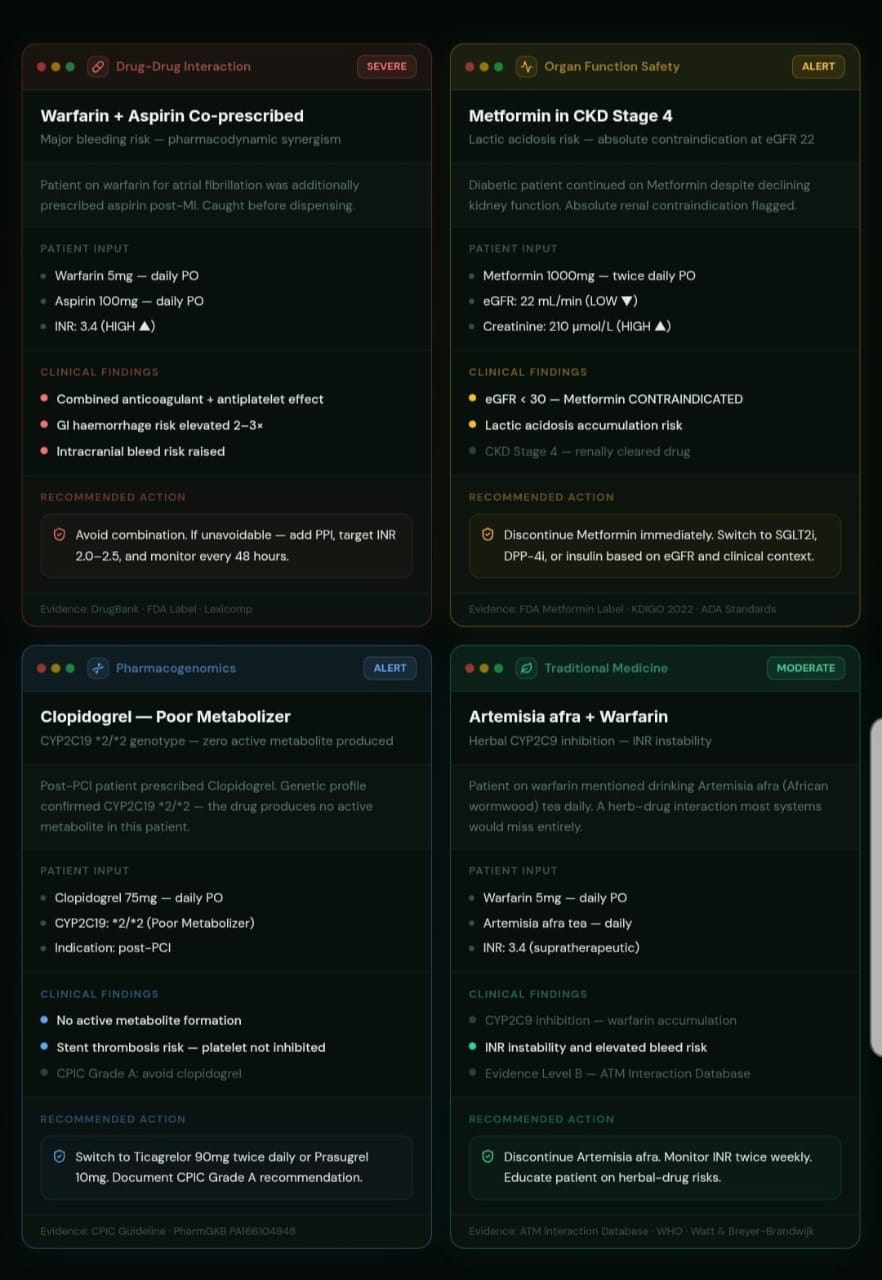
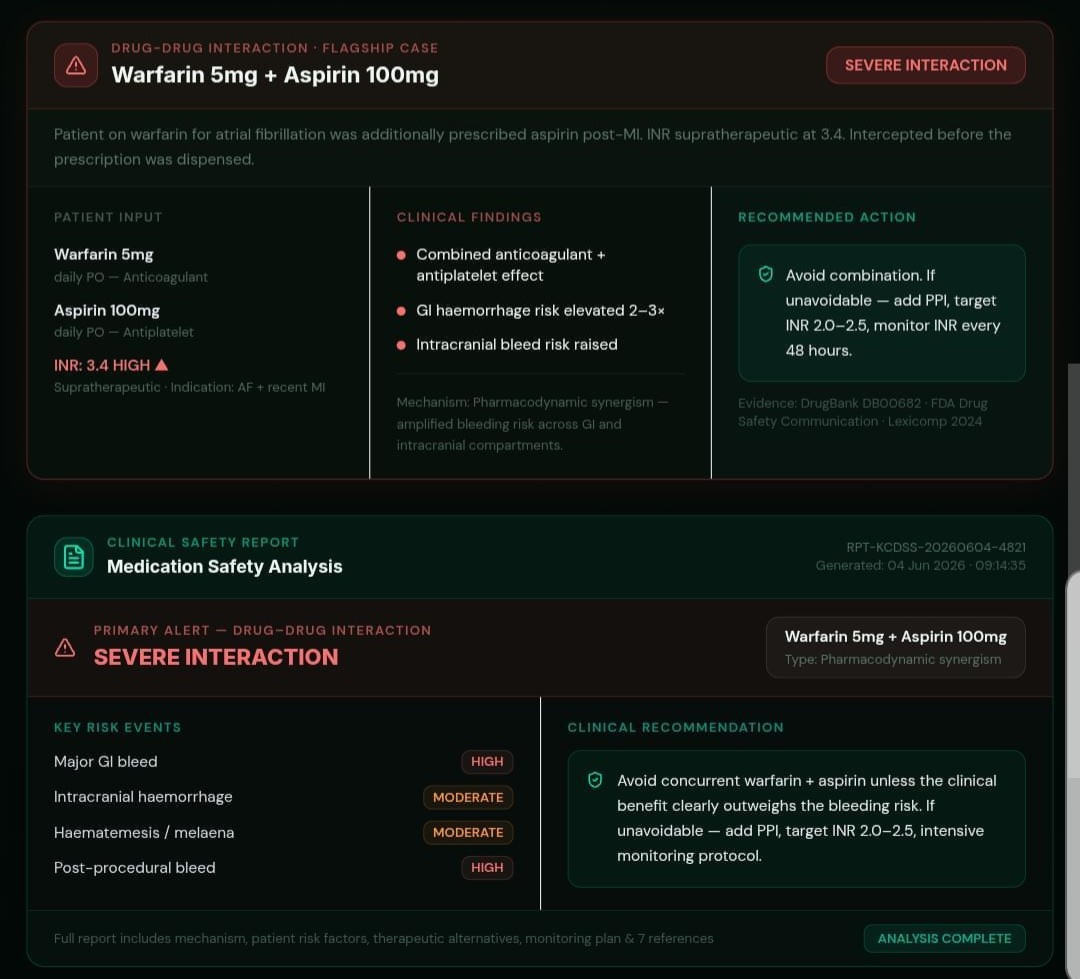
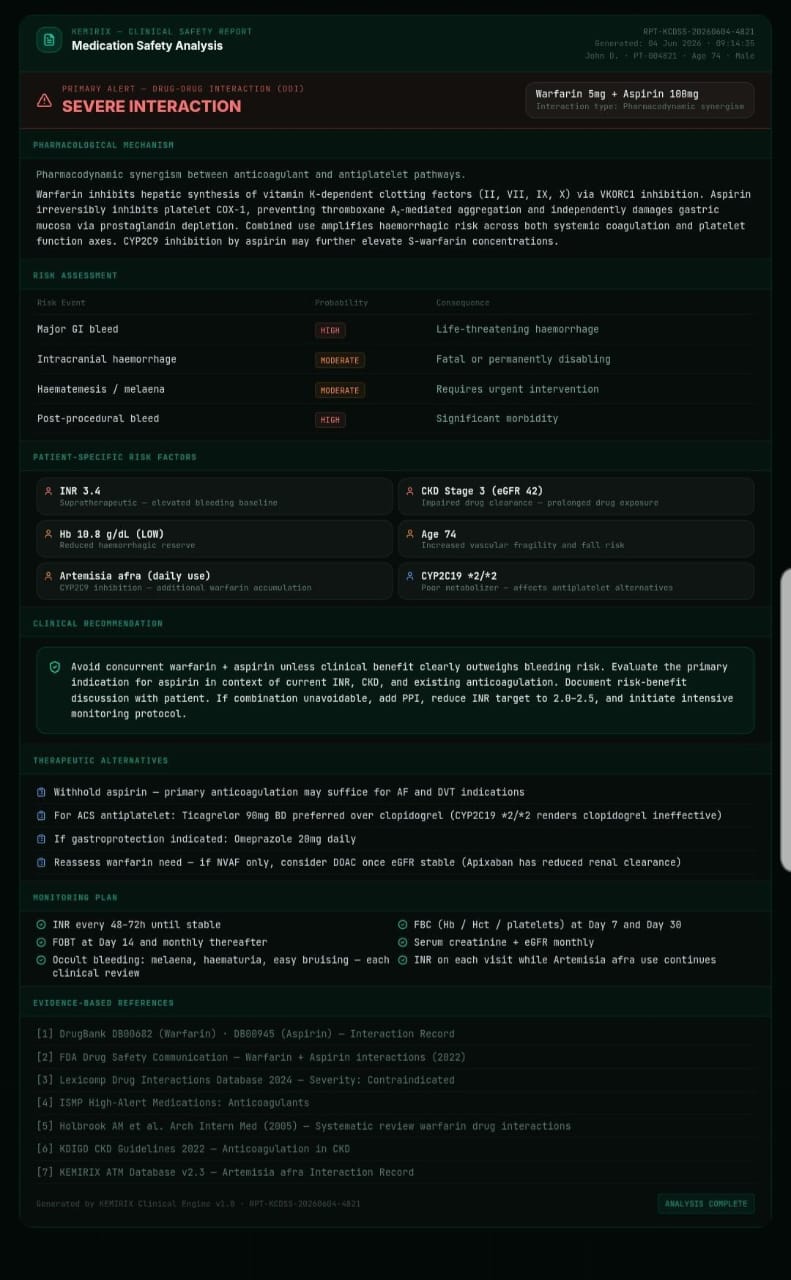
- Drug interaction alerts across 4 medicine systems
- Pharmacogenomics flags before prescribing
- Lab trend analysis and missed abnormal value detection
How KEMIRIX Helps
KEMIRIX becomes your clinical co-pilot — not replacing your judgment, but ensuring you never miss a dangerous interaction, a missed abnormal, or a pharmacogenomic risk that your patient carries.
30 Critical Healthcare Problems.
30 KEMIRIX Solutions.
Every problem below is a real, documented challenge in African and Asian healthcare systems. Every solution is a specific, deployable KEMIRIX capability. These happen every day, to real people.
The Doctor Shortage
1 Doctor for 5,000+ Patients
Source: WHO Global Health Observatory
Africa has one of the worst doctor-to-patient ratios. Kenya has fewer than 10,000 registered doctors for 55 million people. WHO recommends 1 per 1,000. Counties like Turkana face 1 doctor per 80,000 patients.
Misdiagnosis — Africa's Silent Epidemic
Misdiagnosis rates exceed 50% for common conditions in sub-Saharan Africa
Source: WHO/Lancet
Malaria is over-diagnosed — clinicians prescribe antimalarials for any febrile illness — while typhoid co-infections, meningitis, and HIV presentations are missed. Overworked clinicians cannot do thorough differential diagnosis.
Lab Result Interpretation — Numbers Without Meaning
Millions of patients receive lab results with no clinical explanation
Source: Kenya MOH Reports
Patients are handed printouts with haemoglobin values, MCVs, MCHs — and told 'come back next week.' Critical values like creatinine 8.9 mg/dL or potassium 6.8 mEq/L are not recognised as emergencies.
Drug-Drug Interactions — Modern Polypharmacy Crisis
HIV patients take 3–6 ARVs simultaneously; elderly patients may take 10+ medications
Source: WHO/Kenya MOH
Kenya's hospital dispensaries have basic drug interaction checkers — slow, outdated, covering only a fraction of known interactions, bypassed entirely at rural centres and chemists. Dangerous combinations are dispensed every day.
Drug Interactions With Ayurvedic Medicine
700 million Ayurveda users globally; significant Indian diaspora in Kenya
Source: AYUSH Ministry
Patients take Ashwagandha, Triphala, Brahmi, Guggul, Turmeric extract alongside hospital medications. Clinicians know almost nothing about Ayurvedic pharmacology. Drug interaction databases cover 0% of Ayurvedic compounds.
Drug Interactions With Traditional Chinese Medicine
1.5 billion TCM users across Asia and diaspora communities in Africa
Source: WHO
St. John's Wort reduces plasma levels of ARVs, immunosuppressants, and anticoagulants by inducing CYP3A4. Dan Shen interacts severely with warfarin. Licorice root raises blood pressure and opposes antihypertensives.
Drug Interactions With African Traditional Medicine
Over 80% of Africans use traditional medicine as primary or complementary care
Source: WHO AFRO
Moringa, Artemisia annua, African wild potato (Hypoxis), Sutherlandia, Neem — taken by millions daily. None in standard formulary systems. Clinicians never ask, patients never tell — stigma around traditional medicine in hospitals.
Drug-Food Interactions — What You Eat Can Kill Your Medicine
Warfarin dose can be doubled or halved by dietary vitamin K intake
Source: DrugBank/PharmGKB
Patients are not told that Warfarin dose is affected by sukuma wiki, terere, and kunde — daily staples in Kenya. Grapefruit juice inhibits CYP3A4. Dairy neutralises tetracyclines. Nobody explains this in African food terms.
Lifestyle Guidance — Sleep, Diet, Exercise in Clinical Context
Lifestyle factors cause and worsen virtually every chronic disease — systematically unaddressed in African public health facilities
Source: WHO
A diabetic is told 'eat less sugar' — not what to eat, how to cook it, affordable substitutes. A hypertensive told 'exercise more' — not what is safe given their BP level. Medication-induced insomnia (efavirenz causes vivid dreams) treated with sleeping pills instead of timing adjustment.
Pharmacogenomics — Why the Same Drug Kills Some and Cures Others
G6PD deficiency affects 20% of Kenyans; CYP2D6 ultra-rapid metaboliser more common in East Africa
Source: PharmGKB/H3Africa
In Africa and Asia, G6PD testing before antimalarials, HLA-B*57:01 testing before abacavir, CYP2C19 testing before clopidogrel are almost never done. African and Asian populations carry the highest global prevalence of exactly these variants.
The Radiology Backlog — X-Rays That Nobody Reads
Africa has fewer than 2,000 radiologists for 1.4 billion people
Source: WHO/RANZCR
Most Kenyan public hospitals have functional X-ray machines but no on-site radiologist. TB — which kills 500,000 Africans annually — means an unread chest X-ray is weeks of ongoing transmission. Lung cancer, pleural effusion, cardiomegaly missed on plain films.
Pathology Crisis — Cancer Diagnosed Too Late or Never
Africa has fewer than 900 pathologists for 1.4 billion people
Source: African Society of Laboratory Medicine
Biopsies sit unreported for months. Cancer patients die waiting for histology. Cervical cancer — Kenya's leading cancer killer of women — requires cytology reading unavailable in most districts. Breast cancer biopsies may take 6–8 weeks.
ECG Misinterpretation — Heart Attacks Missed at the Gate
STEMI is routinely misread as 'normal' by non-specialist clinicians in district hospitals
Source: Kenya Cardiac Society
ECGs require years of training to interpret accurately. Clinical officers miss STEMI. The golden 90-minute window for thrombolysis or PCI is missed. The patient dies or survives with severe cardiac damage.
Oncology Without Oncologists — Cancer Treatment in the Dark
Kenya has fewer than 30 oncologists for 55 million people, mostly in Nairobi and Mombasa
Source: Kenya Cancer Network
Genomic profiling of tumours — standard of care globally — available at only 2–3 centres in all East Africa. Clinicians cannot interpret genomic results. Targeted therapy prescribed by trial and error.
Chronic Disease Prediction — Diabetes 7 Years Too Late
Type 2 Diabetes diagnosed on average 7 years after onset in Kenya
Source: Kenya Diabetes Management & Information Centre
By diagnosis, 50% of patients have peripheral neuropathy, 20% retinopathy, 10% nephropathy — all irreversible. Pre-diabetes, a detectable and reversible state, is almost never diagnosed in Kenyan public health facilities.
Fragmented Health Records — The Patient Who Carries Paper Files in a Plastic Bag
Average Kenyan patient attends 3+ unconnected facilities with no shared records
Source: Kenya MOH
Every hospital has its own card. Dangerous drug combinations initiated across facilities. Same expensive tests repeated 3 times. Patients who cannot remember medication names receive wrong treatment in emergencies.
Language Barriers in Healthcare
Kenya has 42+ ethnic communities; Northeast Kenya has some of the worst health indicators nationally
Source: KNBS
Medical instructions in English or Swahili delivered to patients whose primary language is Somali, Kikuyu, Luo, Kamba, or Kalenjin. Medication non-compliance in East Africa is partially a language comprehension problem.
Emergency Referral Failures — No Records, No Time, No Information
ER teams start from zero on unconscious patients — no allergy, medication, or condition history available
Source: Kenya Emergency Medicine
In time-critical emergencies — STEMI, stroke, eclampsia, anaphylaxis — every minute spent on information-gathering is a minute the patient is not being treated.
Slow Hospital Software — Technology That Works Against Clinicians
Kenyan public hospital HIS systems regularly lag, crash, and lose data
Source: Kenya MOH Digital Health Reports
Pharmacists navigate systems taking 30 seconds per screen. Radiologists fill paper forms because digital systems are down. Billing clerks manually re-enter data into 3 disconnected modules.
Antibiotic Resistance — The Pandemic Africa Cannot See
AMR projected to cause 10 million deaths annually by 2050; Africa will bear the largest burden
Source: WHO/IACG
Antibiotics sold over-the-counter in Kenya without prescription. Clinicians over-prescribe broad-spectrum because they lack rapid diagnostics. Patients buy half-courses because they cannot afford the full prescription.
Digital Prescription — The Paper Prescription Problem
Paper prescriptions are altered, lost, forged, and misread daily in Kenya's pharmacy network
Source: PPB Kenya
Clinicians write illegibly. Patients lose prescriptions. Prescriptions are altered or forged. Patients buy only what they can afford without telling anyone. Counterfeit drugs dispensed against paper prescriptions.
Lab Access Gap — The Test Recommended But Never Done
Massive gap between clinician recommending a test and patient completing it
Source: Kenya Health Policy Reports
Patient told to 'get a Full Blood Count' does not know which lab, how much, whether fasting required, which labs accept NHIF, how to get results back to clinician.
Omni-Channel Access Gap — Healthcare AI That Serves Only 20% of the Population
Smartphone penetration ~40% in Kenya; ~15% in rural Kenya
Source: GSMA Mobile Economy Africa
Every existing clinical AI tool requires smartphone + internet + often a paid subscription. Clinical intelligence serves only the urban middle class — perhaps 20% of Kenya's population. The 80% who need it most are excluded by design.
Wearable Blind Spot — Continuous Data That Nobody Analyses
Affordable wearables increasingly present in African urban markets; data siloed, unanalysed
Source: GSMA
Patients take weekly blood pressure readings into a notebook no clinician sees. Diabetics record glucometer readings their doctor glances at for 30 seconds. The trajectory of that data — the slow creep of morning glucose over 3 months — contains early warnings nobody sees.
Mental Health Invisibility — The Disease Kenya Does Not Talk About
Kenya has 0.19 psychiatrists per 100,000 population — fewer than 200 for 55 million people
Source: WHO Mental Health Atlas
Mental health conditions affect an estimated 25% of Kenyans at some point. Almost entirely untreated. Stigma prevents care. Clinicians at primary level have minimal mental health training. Psychiatric medications carry significant interaction risks.
Healthcare Student Education — Learning Without Resources
African medical and pharmacy students have no access to UpToDate ($600/year) or equivalent clinical reference tools
Source: African Medical Education Consortium
Students in institutions with inadequate library access, outdated textbooks, no live drug interaction checkers during rotations. The education gap between African healthcare students and their peers in high-income countries is a resource gap, not an intelligence gap.
Research Data Void — Africa's Health Data Does Not Exist
Clinical trial data is predominantly from European and North American populations
Source: Lancet/BMJ
Africa is treated with medicines dosed and studied in other populations, with guidelines written for other patients. KEMRI and other African institutions produce excellent science but are constrained by data access and inability to aggregate patient-level clinical data at scale.
Cost Invisibility — Healthcare Patients Cannot Plan or Afford
Patients leave pharmacies with partial prescriptions — buying 3 days of antibiotics instead of 7
Source: Kenya National Health Accounts
Healthcare cost invisibility is a clinical problem, not just financial. Patients present with advanced disease because they delayed care without knowing if they could afford treatment. NHIF coverage is confusing and inconsistently applied.
Maternal and Child Health — Where Preventable Death Is Most Common
Kenya's maternal mortality ratio is 342 per 100,000 live births vs 23 in the UK
Source: Kenya DHS / WHO
Pre-eclampsia, postpartum haemorrhage, sepsis, obstructed labour — all detectable and manageable with timely intervention. A nurse who does not recognise early pre-eclampsia. A mother who does not know warning signs of pneumonia in her infant.
Federated Intelligence — Africa's Clinical Data Sovereignty
Every major clinical AI platform is American or European; African hospital data improves products priced for Western markets
Source: Lancet Digital Health
Africa's clinical data is a resource — the most valuable healthcare resource on the continent — leaving Africa without compensation or sovereign control. This is the current state of global health AI.
Showing 30 of 30 problems
Comprehensive Coverage
THE FOUR MEDICINE SYSTEMS
KEMIRIX is the world's first clinical AI that integrates all four major global medicine systems simultaneously — because your patients don't live in a single pharmacological world.
Allopathic / Modern Medicine
Sources: DrugBank (complete database), OpenFDA, RxNorm, Kenya STG/EML 2023, WHO Essential Medicines List
- Drug-drug interactions with mechanism explanation
- Pharmacogenomics screening (G6PD, CYP2D6, HLA-B*57:01)
- Adverse drug reaction monitoring via OpenFDA
- Antimicrobial stewardship with resistance surveillance
- Cancer genomics integration for targeted therapy
Ayurvedic Medicine
Sources: NAPRALERT, AYUSH Research Portal, Dr. Duke's Phytochemical Database
- CYP enzyme effects of Ayurvedic herbs
- Ashwagandha: CYP3A4 + CYP2D6 inhibition
- Guggul + Garlic: anticoagulant activity
- Bitter Melon + Fenugreek: hypoglycaemic effects
- Full pharmacokinetic profiles for 50+ herbs
Traditional Chinese Medicine
Sources: TCMID 2.0, YaTCM, NAPRALERT ethnopharmacology database
- St. John's Wort: CYP3A4 induction reducing ARV levels
- Dan Shen: severe interaction with warfarin
- Licorice root: blood pressure opposition with antihypertensives
- TCM formula disaggregation to component herbs
- Covers diaspora TCM use in East Africa
African Traditional Medicine
Sources: PRELUDE (African plants), KEMRI ethnobotany literature, Field herbalist surveys
- Hypoxis (African potato): immune modulation, HIV/ARV risk
- Sutherlandia: CYP3A4 induction reducing ARV levels
- Moringa: antiplatelet and hypoglycaemic activity
- Artemisia annua: antimalarial, cardiotoxicity at high doses
- Africa's first ATM drug interaction database
Your patient takes Ashwagandha, Moringa, St. John's Wort, and an ARV.
No other clinical AI on Earth can check that combination for interactions. KEMIRIX can.
Under the Hood
THE INTELLIGENCE PIPELINE
12 deterministic layers. No guessing. No hallucination. Every output traceable.
Detects text / image / lab-PDF / ECG-XML — routes to correct specialist module
Resolves drugs and herbs to canonical IDs across Allopathy, Ayurveda, TCM, and African Traditional Medicine
Population-specific variant lookups. Flags African population PGx risks — G6PD, CYP2D6, HLA-B*57:01
Tier-1 and Tier-2 fan-out covering African foods and all 4 medicine systems simultaneously
Gatherer dispatches imaging specialists in parallel — async, deterministic, bounded latency
Evidence retrieved per clinical claim. BiomedBERT-indexed. Every assertion grounded in a verifiable source.
Tier 1 sources = infinite weight. Licensed databases override any AI output. No exceptions.
Independent clinical verifier critiques draft output, flags inconsistencies, checks diagnostic logic
Every assertion linked to a retrieved, verifiable source. No uncited clinical claims pass this layer.
8 confidence states: HIGH_CONFIDENT through REFUSE. System refuses rather than hallucinating.
Same evidence pack formatted for Doctor, Nurse, Pharmacist, Patient, Radiologist, Student — each gets what they need.
Every output stored with full provenance. Clinician overrides become training signals for model improvement.
Veto Authority Sources — Weight: ∞
DrugBank
Drug interactions + safety
∞
Weight
OpenFDA
Adverse events + recalls
∞
Weight
PharmGKB / CPIC
Pharmacogenomics guidelines
∞
Weight
Refuse when uncertain. Tier 1 veto is absolute. Every clinical claim cites a verifiable source. No PHI ever leaves the trust boundary. Clinician-in-the-loop for every patient-affecting decision.
Platform Capabilities
One Platform. Complete Clinical Coverage.
KEMIRIX combines 12 layers of clinical intelligence into a single, unified decision support system.
4-System Drug Interaction Checker
Real-time screening across Allopathy, Ayurveda, TCM, and African Traditional Medicine simultaneously. Hard-gate veto logic powered by DrugBank.
Pharmacogenomics Engine
Africa's first embedded PGx engine. G6PD, CYP2D6, HLA-B*57:01, CYP2C19 — African population variants covered. Tests recommended when profile unavailable.
Differential Diagnosis AI
Multi-layer clinical reasoning. Ranked differential with confirmatory tests. Confidence states — refuses when uncertain rather than guessing.
Medical Imaging Intelligence
Chest X-ray (TB, 14 pathologies), ECG (STEMI, AFib, WPW), diabetic retinopathy, and cervical cytology. Smartphone photo upload. 60-second pre-read.
African Traditional Medicine DB
Africa's first ATM drug interaction database. Hypoxis, Sutherlandia, Moringa, Artemisia, Neem — pharmacologically profiled for the first time at scale.
Digital Prescription System
Cryptographically signed prescriptions. QR codes via SMS. Pharmacy routing with cost comparison. M-Pesa payment integration. Forgery-proof.
Lab Result Interpretation
Upload any lab result — photo, PDF, or typed values. Plain-language clinical narrative. Critical value alerts. Results stored in FHIR R4 vault.
Physician Cortex Review
Every AI output above confidence threshold passes through a licensed physician before reaching any patient. 45-second review. Zero autonomous patient decisions.
Federated Architecture
Patient data never leaves the originating facility. Models train locally. Intelligence — not data — is shared. African clinical data sovereignty by design.
Offline-First + USSD
Works in rural Kenya with zero internet. USSD delivers triage on any feature phone at zero data cost. WhatsApp bot for smartphone users without app downloads.
Access Equality
FIVE CHANNELS. ONE INTELLIGENCE.
Access equality is not optional. KEMIRIX serves every Kenyan — not just those with smartphones.
Smartphone App
Full feature access. Drug interactions, record vault, imaging upload, care plans, wearable sync, pharmacogenomics, educational mode.
~40% of Kenyans
WhatsApp Bot
97% of Kenyan smartphone users already have WhatsApp. Upload lab results, get drug interaction checks, receive triage guidance. No download required.
~38% of Kenyans
USSD
The most important channel. Dial a short code on any phone — feature phone, no internet, zero data cost. Symptom checker, triage, referral routing — in Swahili.
100% of Kenyans
Web Portal
Browser access for patients at cyber cafes and clinicians on desktop systems. Full clinical intelligence accessible via any browser, no app required.
Any browser, anywhere
SMS
Result notifications, booking codes, prescription QR codes, appointment reminders. The last mile for patients with no data plan or smartphone.
100% of mobile users
80%
of Kenyans excluded by smartphone-only platforms
5
simultaneous channels launched on day one
100%
of Kenyans with mobile access can reach KEMIRIX
The Team
Built by Clinicians and Engineers
A team uniquely positioned at the intersection of medicine, engineering, and African healthcare.
Emmanuel Bain
Co-Founder & CEO
AI/ML Engineer and Pharmacy specialist who designed and built the KEMIRIX clinical AI engine from the ground up. Architect of the 12-layer deterministic pipeline.
Siham Deq Hassan
Co-Founder & CMO
Medical Student driving KEMIRIX's clinical validation strategy, ensuring every feature is grounded in real-world medical accuracy and clinical workflow.
Abu Bakr Dahir Hassan
Senior Fullstack Developer & AI/ML Engineer
Responsible for developing the training pipeline, model architecture, and the full-stack infrastructure of the KEMIRIX platform.
Regulatory Compliance & Licensing
Join the KEMIRIX Intelligence Network
Clinicians, researchers, and health system leaders receiving KEMIRIX updates on clinical AI, pharmacogenomics, and African healthcare innovation.
No spam. Unsubscribe anytime.
Ready to deploy KEMIRIX at your facility?
✦ Bismillahi Rhamani Rhaheem · Africa First. World Next.